5,306,282 DATED APRIL 26, 1994
HIGH
INCISION VELOCITY VIBRATING SCALPEL STRUCTURE & METHOD
VIBRO™
|
|
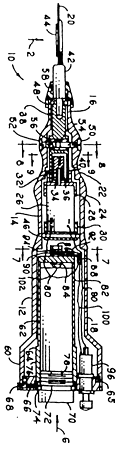
The purpose of this invention is to minimize scar formation by adding velocity to the incision. In the past, surgical scalpels have generally been elongated handles with straight scalpel blades secured to one end thereof, which have been drawn across tissue to be incised manually.
The invention relates to surgical scalpels, and refers more specifically to a high incision velocity vibrating scalpel structure and method of power driving a scalpel blade, which structure may be completely self contained so as to be useful in remote areas without local power sources and by which structure and method a conventional linear scalpel blade is vibrated at a high velocity to produce incisions in tissue which heal rapidly with little or no scar formation.
In the past, surgical scalpels have generally been elongated handles with straight scalpel blades secured to one end thereof, which has been drawn across tissue to be incised manually.
More recently, it was discovered that utilizing a rotary scalpel blade and either drawing the rotary scalpel blade across tissue to be incised at a predetermined speed with the scalpel blade being rotated due only to the friction of the blade with the tissue, or driving the scalpel blade at a predetermined velocity while it is being drawn across tissue to be incised, produces incisions which heal rapidly and with substantially less scar formation than with the use of straight bladed manually actuated scalpels.
Still more recently, the present inventor has found that surgical incisions may be made in living human tissue which also heal rapidly and produce a minimum of scar tissue, utilizing conventional straight scalpel blades which are vibrated fore and aft linearly within the plane of the curved cutting edge at high velocity while being drawn across tissue to be incised. Further, unique structure for linearly vibrating a straight scalpel blade at a high incision velocity has been developed which is simpler than that required for producing rotary motion of rotary scalpel blades, producing the same surgical results, which is therefore less expensive to produce for the surgical purpose.